Hearth and Bills: The Unromantic Truth About Old Fireplaces
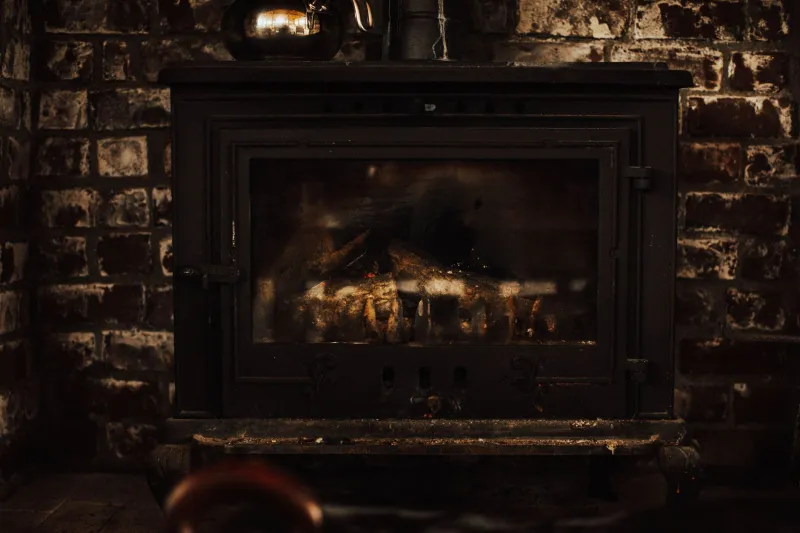
You see the fireplace before you see the damp patch. That is the trouble with character homes: the hearth does the emotional heavy lifting, and the arithmetic arrives later, usually in a surveyor's report with a paragraph about 'further investigation'.
A fireplace is a lovely thing. It is also a hole in the wall connected to a stack of brickwork that has been quietly doing its own thing for a century. Until you know what is actually up there, the fire is a stage set. The useful question is not 'does it look nice?' but 'what would it take to make it safe, legal and worth lighting?'
The romance is doing a lot of work
Open fires are inefficient in a way that is almost impressive. Most of the heat goes up the chimney, not into the room. A well-run wood-burning stove is a different proposition, but it is still a appliance with rules, servicing and a fuel bill. The fantasy is a glass of wine and a stack of logs. The reality is a sweep, a certificate, a liner and a conversation about smoke control areas.
None of that means don't buy the house. It means price the fireplace as a project, not a feature.
First, find out what is actually there
A chimney sweep can tell you a lot. A proper flue survey tells you more. That usually means a CCTV inspection of the flue, checking for a liner, breaches, awkward bends and the condition of the parging. Expect to pay somewhere in the region of £200 to £400, depending on access and how many flues you have. It is money well spent before exchange, because a failed flue can turn a £2,000 stove project into a £6,000 chimney rebuild.
Ask whether the flue is shared with a neighbouring property — common in terraces and old cottages — and whether any appliance has been removed without the flue being capped correctly. Ask, too, whether the chimney is original or a later addition. A Victorian stack on a Georgian cottage is not impossible, but it is worth knowing what you are dealing with.
Damp, draughts and the chimney you don't use
An unused chimney is not a sealed box. It is a ventilation stack, and if you block it without thought you can end up with damp, condensation and a smell that is hard to trace. Hygroscopic salts in the brickwork can pull moisture out of the air and leave tide marks on the chimney breast. The answer is usually controlled ventilation, not a bucket of sealant.
If the fireplace is decorative only, a ventilated cap and a maintained air path will often do more good than stuffing a draught excluder up the flue. If you are keeping the fire working, the chimney still needs air to burn safely. Rooms in old houses are often already short of it. Do not assume a new stove will solve a ventilation problem; it may simply expose it.
Wood burners: the rules have tightened
In England, smoke control areas still matter, and the rules around solid fuel appliances have become firmer over the last few years. If you are in a smoke control area, you need a DEFRA-exempt appliance or a properly authorised fuel. Building Regulations Document J covers installation, hearths and flue heights, and a HETAS-registered installer is the sensible route for most people. In a listed building or a conservation area, external flue work and alterations may need consent. Check before you buy the stove, not after.
A stove is not a loophole. It is a controlled combustion appliance, and it needs the right flue, the right air supply and the right fuel. Wet logs and a badly lined chimney are a miserable combination.
The bill you don't see coming
A straightforward liner and stove installation might land between £3,000 and £5,000. Add a new hearth, register plate and some chimney repointing, and you can push towards £7,000 or £8,000. A full stack rebuild with scaffolding can go higher. Then there is the annual sweep — roughly £80 to £150 — and the logs, which are not free unless you have a very good relationship with a tree surgeon.
Compare that with the heat you actually get. An open fire is often quoted at around 20% efficiency; a modern stove can be 70% or more. Neither is a substitute for a properly insulated house. If the rest of the property is cold and draughty, the fireplace is a mood piece with a fuel bill.
Insurance and the small print
Tell your insurer what you have and what you use. Some policies require proof of sweeping or a professional installation certificate. An unused chimney is usually fine, but a blocked or capped flue that has not been maintained can become a get-out clause if something goes wrong. If you rent, ask the landlord for the last sweep certificate and written permission before you light anything. A pretty fireplace in a rental is not automatically a working one.
The honest verdict
Pay for the fireplace you will actually use, and pay for the survey that proves it works. If the flue is sound, the chimney is accessible and the rules allow it, an old fireplace can be one of the great pleasures of a period house. If it is a decorative hole with a soot-stained past, treat it as exactly that: a feature. Lovely, but not a reason to stretch the budget. The hearth should follow the house, not make the decision for you.