Before the Beams, Check the Board: An Old-House Electrical Audit
There is a moment in every old-house viewing when the estate agent says something like, ‘And of course, it is full of character,’ while you are quietly wondering whether the cupboard under the stairs is hiding a fuse board or a museum exhibit. The beams, the flagstones and the wonky staircase all do their bit. But if you are buying a period property, the electrics deserve a proper look before your heart signs anything.
This is not about being gloomy. Old houses can have perfectly sound wiring, and plenty do. The point is that electricity is one of the few parts of a house where charm offers no clues at all. A beautiful Georgian façade can sit above a circuit arrangement that was last improved during a wet weekend in the 1980s. You need to read the evidence.
Start where the photographs never go
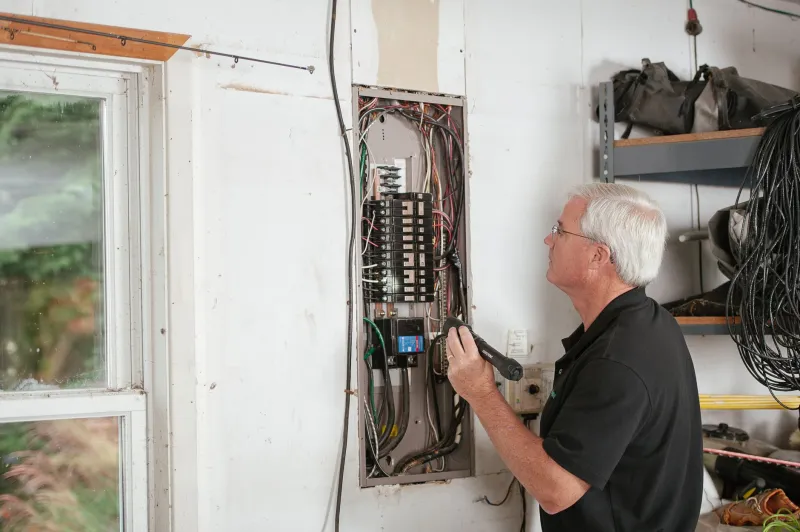
Ask to see the consumer unit. It is usually in a hall cupboard, a garage, a pantry or a slightly awkward spot beside the back door. What you are looking for is not just whether it is old, but how it has been looked after.
A modern board with clear labelling, residual current device protection and a sensible layout is reassuring. A wooden-backed board with rewirable fuses, a tangle of exposed tails and a handwritten label saying ‘sockets — mostly’ is not necessarily a disaster, but it is a conversation. So is a board with several small add-on units around it, as though previous owners kept bolting on solutions rather than planning the whole thing.
Look at the meter area too. Is there an isolator? Is the earthing arrangement visible and labelled? Are there cables entering the building in a way that looks deliberate, or has something been drilled through a wall and sealed with hope? You do not need to be an electrician to notice when a job looks improvised.
The small clues around the rooms
Sockets tell a story. A period house with one double socket in a bedroom and a trailing extension lead under the carpet is telling you that modern life has arrived without the wiring being updated. Surface-mounted trunking, cables clipped along skirting boards and sockets set at odd heights can all be signs of later additions rather than a planned rewire.
Be wary of the shiny new kitchen that has been dropped into an old electrical system without any visible upgrade. A kitchen is the hardest-working room in the house for circuits: oven, hob, extractor, dishwasher, washing machine, kettle, toaster, fridge and perhaps an instant hot tap. If the board looks ancient but the kitchen looks new, ask what was actually done.
Outside, look at any garden sockets, outside lights or garage supplies. Ask yourself whether they look weatherproof and properly installed. Inside, check the bathroom for a pull cord or wall switch that feels loose, and the loft for cables lying across joists without protection. None of these things is proof of a problem. They are simply prompts for better questions.
What a survey does and does not cover
A standard building survey is not an electrical inspection. A surveyor may note visible signs — an old fuse board, a lack of sockets, evidence of amateur work — but they will usually recommend further investigation by a qualified electrician. That is not a cop-out. It is the correct boundary.
The report you actually want is an Electrical Installation Condition Report, usually shortened to EICR. It should be carried out by a registered electrician, and it should give you more than a vague verdict. You want the schedule of inspections and the observations, with any issues coded. In simple terms, the report will flag things that are immediately dangerous, things that are potentially dangerous, and things that are merely improvements. It will also note limitations, because no electrician can inspect every cable buried in a wall without opening the house up.
Do not accept ‘it passed’ as a full explanation. Ask for the report itself. Ask what the remedials would cost and whether they are urgent. If recent work has been done, ask for certificates and for evidence that notifiable work was signed off. In England and Wales, most domestic electrical work has been notifiable under Part P for years, and paperwork is a useful sign of care. It is not a guarantee, but a seller who has kept the certificates is usually a seller who has taken the house seriously.
Questions worth asking the seller
Keep them plain. When was the consumer unit last replaced? Has the house been rewired, and if so, when? Who did the work? Are there certificates for the kitchen, the shower, the outside lights or the loft conversion? Has an EICR been done in the last few years, and can you see it?
You may get vague answers. That is useful information in itself. A seller who says, ‘It was all done before we moved in, we have never touched it,’ is not necessarily hiding anything. But you should price the risk accordingly.
The rewire conversation
A full rewire is not a small job in a period house. Cables need to reach places that were not designed for them. Walls may need chasing, floors lifting, plaster patching and decoration redone. In a listed building or conservation area, you may need consent for certain alterations, and the route of cables can become a conservation conversation rather than just an electrical one.
In 2026, a full rewire of an ordinary period house might sit somewhere in the low five figures, depending on size, region, access and how much making good you want done at the same time. A larger house with complex routes, a kitchen refit and extensive plaster repairs can go beyond that. A partial upgrade or a new consumer unit is cheaper, but it is not the same thing. Do not let a quote for a new board persuade you that the whole installation has been made modern.
Budget separately for the mess. Rewiring is a sequence: first fix before plastering, second fix after. If you are renovating anyway, fold it into the plan early. If you are moving in first, decide how you will live with temporary sockets and limited power. And build in a contingency. Old houses rarely reveal their electrical layout in a neat order.
The sensible conclusion
The electrics should not decide whether you love a house. They should decide how you negotiate, what you budget and whether you need to walk away. A dated board is a known cost; a hidden mess is a surprise. Get the report, read the detail, ask for certificates and price the worst realistic case.
The beams will still be there when the plaster dust settles. The fuse box, however, has been telling the truth all along.