Where the Garden Really Ends: A Boundary Check for Period Homes
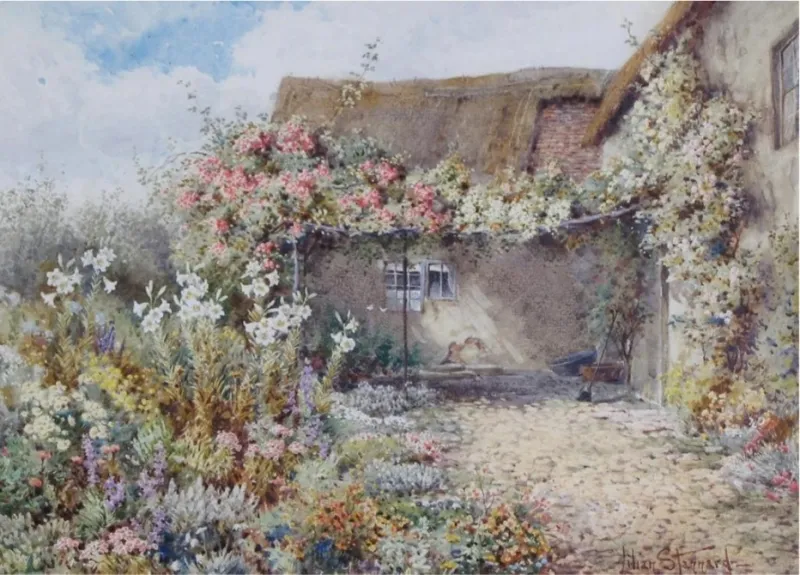
Photo: Lilian Stannard, Public domain, via Wikimedia Commons
There is a particular kind of confidence that comes from standing at the end of a period garden, looking back at the house, and thinking: yes, this is all mine. The hedge is tidy. The fence has a gate. The lawn stops somewhere sensible. It feels finished.
Then your conveyancer sends over the title plan and a few old deeds, and the line on the drawing does something slightly different from the line on the ground. Not dramatically. Just enough to make you wonder whether the mature oak by the shed is yours, theirs, or a matter for a future neighbourly disagreement.
Garden boundaries are one of the quietest sources of trouble in an old-house purchase. Nobody falls in love with a cottage because of a party fence wall covenant. But boundary uncertainty has a habit of surfacing later — when you sell, when a neighbour extends, when a hedge comes down, or when someone decides the parking space by the back gate was always theirs.
Start with the plan, not the privet
When people say “the deeds”, they often mean the title register and title plan held by HM Land Registry, plus any older documents that still carry weight. The title plan is useful, but it is not a survey. For most registered land it shows general boundaries — a reasonably accurate indication of where the property sits, not a millimetre-perfect map of every fence post and shrub.
That matters. A thick red line on a plan can look authoritative while still leaving room for interpretation. The plan might show the boundary running along the back of a hedge, while the hedge itself has crept two feet into the neighbouring field over forty years. Or the plan might include a strip of garden that the seller has never actually used, because a previous owner fenced it off in the 1970s and everyone shrugged.
So read the plan alongside what you can see. Ask your conveyancer to explain any obvious mismatch: a fence line that cuts through a title, a garden that appears to include a neighbour’s access strip, or a boundary that runs through a shared wall. You are not looking for perfection. You are looking for anything that might need a conversation before exchange.
The fence is not a legal document
A fence is a useful social signal. It says: this far, roughly. It does not, on its own, prove ownership or responsibility. In England and Wales there is no general rule that the fence on the left belongs to the house on the right, despite what you may hear in a pub or read on a forum.
What matters is what the title documents say. Look for phrases such as party fence wall, party wall, boundary wall, maintenance covenant, or an obligation to contribute towards repairs. Old conveyances can be wonderfully vague — a plan drawn in fountain pen, a clause referring to “the fence heretofore erected” — and those vague phrases can still shape who pays when the wall starts leaning.
If the deeds are silent, responsibility may be unclear. That does not always mean trouble. Many neighbours live happily with an informal arrangement for decades. But if you are buying, you should know that the arrangement is informal. Ask the seller what they have paid for, what the neighbour has paid for, and whether there has ever been a dispute. The property information form will ask about disputes, but it is worth asking in person too. Sellers can be honest and still forget the time a boundary hedge was trimmed without permission in 2019.
Shared walls, shared bills and quiet liabilities
Period gardens often come with walls that do more than hold back soil. A brick wall between two gardens might be a party fence wall. A retaining wall might support your neighbour’s higher ground. A shared wall might include a right of support, or a covenant that stops either side from raising the height.
These are not abstract legal points. Retaining walls can be expensive. If a wall is shared, or if it supports a neighbour’s land, repairs may need to be agreed rather than simply commissioned. Ask your conveyancer whether any garden wall is a party structure, whether there are covenants restricting alterations, and whether the seller has any correspondence about repairs.
It is also worth looking at the practical side. Does the wall drain into your garden? Does a neighbour’s shed lean against it? Has someone planted ivy that is quietly doing its worst? A surveyor can comment on condition, but the legal responsibility sits in the documents. You want both halves of the picture.
Hedges, ditches and the two-sided story
Hedges are charming until they are not. They can mark a boundary, provide privacy and shelter, and then grow into a dispute about height, light or maintenance. There is an old presumption about hedges and ditches — broadly, that where a hedge and ditch run together, the boundary may follow the far side of the ditch — but it is a starting point, not a magic answer. It can be rebutted by the deeds, by long use, or by the simple fact that nobody knows who dug the ditch.
If a boundary hedge is shared, or if its ownership is unclear, ask what has happened in practice. Who trims it? Who pays if it fails? Has there ever been a complaint about height? If the hedge is protected by a tree preservation order or sits in a conservation area, you may need permission before doing significant work. That is not a reason to walk away, but it is a reason to check before you buy a chainsaw.
Rights of way and the shortcut you inherit
A garden boundary can also hide a right of way. Perhaps a neighbour has a legal right to cross the end of your garden to reach their bin store. Perhaps a footpath runs along the hedge line and is recorded on the local authority’s definitive map. Perhaps a shared driveway serves three houses and everyone has been parking slightly differently for years.
Check the title for easements and rights of way. Check the local authority’s records for public footpaths and bridleways. Ask the seller how the access works in practice, and whether anything has ever been blocked or disputed. A right of way does not necessarily reduce the value of a house, but an unrecorded or misunderstood one can make a quiet garden feel a lot less private.
Adverse possession: when the map lags behind reality
Adverse possession is the legal idea that someone can acquire title by occupying land without permission for a long period. For registered land the process is not a casual one — it usually involves an application after ten years, and the registered owner is normally notified. For unregistered land, the old twelve-year rule may still be relevant. This is specialist territory, and it is rarely as simple as “the neighbour has used that strip for ages, so it is theirs”.
Still, it is worth asking whether any boundary has moved in living memory. Has a fence been shifted? Has a shed been built over a line? Has a neighbour used a gate or a parking space for decades? If the answer is yes, tell your conveyancer. They can decide whether it matters, whether evidence is needed, or whether an indemnity policy is sensible. Do not rely on a friendly chat over the hedge as your legal due diligence.
Questions to put to your conveyancer before exchange
You do not need to become a boundary expert. You do need to ask clear questions. Try these:
- Does the title plan match the visible boundaries, and if not, why?
- Are there any party fence walls, shared walls or maintenance obligations in the deeds?
- Is there any record of a boundary dispute, or any correspondence about repairs?
- Are there any rights of way, easements or covenants affecting the garden?
- Does anyone else have a key, a gate, a parking space or a shortcut across the land?
- Has any boundary moved, been fenced differently, or been used by a neighbour for a long period?
- Is the garden hedge protected by a tree preservation order or conservation area rules?
A good conveyancer will not be surprised by these questions. They will probably be relieved you asked before exchange rather than after.
The honest bottom line
A beautiful boundary is not the same as a legally settled one. That does not mean every period home is hiding a boundary problem. Most gardens are fine, and most neighbours are reasonable. But old houses attract old arrangements: informal fences, shared walls, half-remembered rights of way and deeds that describe a garden slightly differently from the one you are standing in.
So enjoy the hedge. Admire the wall. Just do not mistake either for a promise. Read the plan, ask the awkward questions, and get the paperwork to catch up with the garden before you exchange.